apr
Mr Nobody against Putin - screening and panel discussion
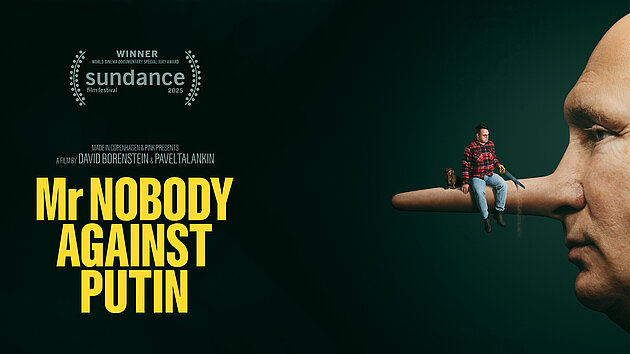
Welcome to a screening of Mr Nobody Against Putin, an award-winning documentary on power, resistance, and propaganda by David Borenstein and Pavel Talankin. Setting the stage for an urgent conversation, it will be followed by a panel discussion featuring Dr Jonathan Andrew, Lilia Chanysheva Morris Wikström.
You are invited to a timely conversation on resistance, responsibility, and the power of storytelling. The conversation takes its point of departure in the film Mr Nobody Against Putin and will be opened by Dr Jonathan Andrew (Geneva Academy), a researcher on human rights, authoritarianism, and the protection of at-risk scholars; Lilia Chanysheva, a Russian opposition activist and former regional coordinator for Alexei Navalny’s movement, who brings firsthand experience of political repression and Morris Wikström, Phd candidate in Russian literature at Lund University.
About the film
The film Mr Nobody Against Putin (2025) won the Academy Award for Best Documentary Feature on 15 March 2026. Just two weeks later, it was banned in Russia. Directed by David Borenstein and co-directed by its subject, Pavel “Pasha” Talankin, the film follows his work at a school in a small mining town near the Ural Mountains, documenting how the Putin regime shapes everyday life through propaganda, surveillance, and control. A beloved teacher and non-conformist, Talankin creates space for independent thought among his students. Following Russia’s full-scale invasion of Ukraine in 2022, he begins filming inside the school, capturing the introduction of state-mandated “patriotic” education, new repressive laws, and the growing militarization of youth. After discovering signs of police surveillance at his home, he fled Russia in 2024.
Panel discussion
The screening will be followed by a discussion with Lilia Chanysheva, a Russian opposition activist who was imprisoned for her work and later released in an internationally negotiated prisoner exchange; Jonathan Andrew (Geneva Academy), currently International Fellow at the Pufendorf Institute and Morris Wikström, PhD candidate in Russian literature. Drawing on research and lived experience, the panel explores authoritarianism, grassroots resistance, and the ethical challenges of engaging with activist testimonies. The discussion will also reflect on the film’s portrayal of political opposition in Russia and consider how scholars and institutions can support colleagues working under repressive conditions.
Practicalities and registration
The language of the film is Russian and it will be shown with Swedish subtitles. The following panel and discussions will be held in English. We will be serving refreshments and here will be time for the audience to ask questions and discuss with the panel after the talk.
Please note that registration to this event is necessary. Link to registration for 22 April, film and panel discussion
BIOs
Liliia Chanysheva is a Russian oppositional regional politician, economist, and former political prisoner, currently studying in the MAS programme in Transitional Justice, Human Rights and the Rule of Law at the Geneva Academy. She previously led Alexei Navalny’s office in Ufa, where she conducted anti-corruption investigations, advocated for the protection of natural landmarks, and mobilized citizens through public hearings, rallies and demonstrations. For her peaceful political activities, she was sentenced by the Russian authorities to nine and a half years in prison and spent two years and nine months in detention before being released in August 2024 as part of an international political prisoner exchange and deported to Europe. Alongside her political and civic work, she has over ten years of professional experience in tax consulting at PwC and Deloitte. She is currently engaged in an independent expert initiative focused on designing policy papers for democratic reforms in a future Russia, including transitional justice, judicial reform, political institutions and security sector governance.
Dr Jonathan Andrew is a Visiting International Fellow at the Pufendorf Institute for Advanced Studies conducting research on the nexus of human rights law with the development of new technologies. Based at the Geneva Academy, he works as a Consultant to UN Special Rapporteurs and the Advisory Committee of the Human Rights Council and has been a Senior Advisor to the Danish Institute for Human Rights. At the European University Institute (EUI) he completed his doctoral studies and worked as the Project Manager for SURVEILLE, a cross-disciplinary collaborative research project funded by the European Commission, where he focused on the impact of the surveillance of mobile devices on freedom of movement, assembly and association. Before joining the EUI, he was the Senior Legal Adviser with the Danish Refugee Council in Tajikistan. His professional experience includes consulting in IT, digital marketing and business process re-engineering.
Morris Wikström is a Phd candidate in Russian literature at Lund University. He writes his thesis on the late Soviet period and the significance of total institutions in Sergei Dovlatov’s writing.
Om händelsen:
Plats: Pufendorf Institute for Advanced Studies, Biskopsgatan 3, Lund (Lecture Hall)
Målgrupp: Students, academic staff
Språk:
The language of the film is Russian and it will be shown with Swedish subtitles. The following panel and discussions will be held in English.
Kontakt: Eva.Perssonpi.luse