Lviv officials visited Lund to strengthen human rights based urban governance
Across Ukraine, cities like Lviv are navigating the dual challenge of post‑war recovery and the long‑term process of aligning local governance with EU standards. Especially veterans and people with disabilities continue to face barriers in accessing services, employment, and rehabilitation. Strengthening inclusive, human rights‑based governance at the municipal level is therefore essential for democratic resilience and sustainable reconstruction.
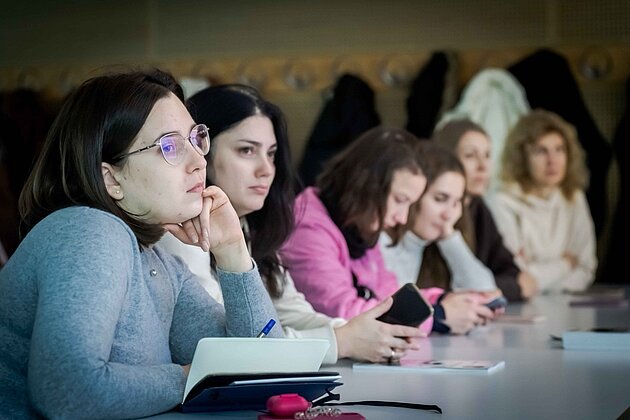
To support this work, EUcation brought Ukrainian local government actors to Sweden for an intensive training week hosted by Lund University in partnership with the Raoul Wallenberg Institute of Human Rights and Humanitarian Law. The programme equipped participants with tools and knowledge to implement EU‑aligned, human rights‑based policies in their own municipalities.
One of the participants was Yuliia Katynska, Deputy Director of the Lviv Bureau of European Integration. Her week in Sweden became a turning point in understanding how European cities translate human rights commitments into everyday governance.
Working at the heart of Lviv’s European transformation
Yuliia coordinates projects and partnerships aimed at aligning Lviv’s governance, youth, and social initiatives with EU standards and policies. Her position places her directly within Lviv’s ongoing transformation, where local reforms and European alignment increasingly shape the city’s development.
Motivation rooted in inclusion and European best practice
— My motivation was to learn more about human rights in the EU and explore best European practices and standards in the social sphere, especially those focused on the inclusive approach and creating a barrier-free environment in communities.
For Yuliia, EUcation offered a chance to connect Lviv’s ambitions with concrete examples from European municipalities.
Learning through practice and local examples
Lund University anchored the week in research‑based knowledge while creating space for participants to connect Swedish experiences with their own municipal realities. The programme emphasised problem‑driven learning, cross‑sector collaboration and practical tools for inclusive governance – aspects Yuliia highlighted throughout the week.
To translate these ideas into practice, the training combined lectures with workshops and study visits to Lund Municipality, Europa Direkt Lund and the City of Helsingborg. Through this combination of academic input and real‑world observations, participants explored approaches to city planning, learned from Swedish experiences in creating inclusive and barrier‑free environments, and deepened their understanding of the EU, including accession experiences and relevant opportunities available.
For Yuliia, these visits were central to connecting theory with practice. Helsingborg made a particularly strong impression. The city’s approach to equality and accessibility, illustrated through the JämtJämlikt FAIRSHARE system, offered a concrete example of how guidelines for accessibility adaptation, public transport, and urban development can be systematically integrated into local governance. This hands‑on experience became a reference point for Yuliia as she moved through the rest of the training week’s sessions. Her reflections show how these elements came together.
— The whole study visit was very intensive and inspiring. I was especially impressed by the lecture on the FAIRSHARE system, the workshop on the ‘problem tree’ method, and the discussion of shadow reports. The sessions on European countries’ experiences on their path to EU membership were very insightful, as well as the visit to Helsingborg and the study tour to Lund University.
New perspectives to bring home
— The most memorable and valuable concept for me was the Human Rights-Based Approach (HRBA) – understanding how it can be practically integrated into local governance, policy-making, and project development to ensure inclusiveness and equality.
For Yuliia, HRBA became a central takeaway: a framework that can strengthen Lviv’s policies and projects while supporting its broader EU integration goals. The final day of the visit gave the participants space to reflect on the week’s insights and link them to their ongoing work in Lviv. Before leaving, they were also tasked with developing a feasible individual initiative, reinforcing how the tools and approaches introduced during the training can be carried forward into local practice in Ukraine.